If you thought the original iteration of WHYS.video was a masterclass in internet sketchiness, the recent website overhaul manages to raise the stakes. They haven’t just updated the paint; they’ve leaned into a hyper-polished, deeply hollow framework designed to simulate legitimacy while throwing up massive red flags under the hood.
The bigger story is that WHYS.video appears to have evolved. It no longer looks like a simple Google-search-driven content farm. It now appears to combine the old model — harvesting questions and answers from Google Search, “People Also Ask,” trending queries, and other search surfaces — with modern AI slop generation. In other words, the operation has not abandoned Google search scraping. It appears to have layered AI-generated summaries, Q&A metadata, and synthetic site structure on top of it.
Here is a technical breakdown of what is actually happening with the new WHYS.video.
- The Phantom Corporate Entity: “Mass Presence LTD”
Update: There was an unrelated “Mass Presence Kft.” registered in Hungary, which dibit.net on our last blog post uses integrity.hu, a Hungarian email service. Interestingly, the Mass Presence Kft company is registered on 2021-05-06, with an industry of “Computer infrastructure, data processing, hosting and related services”, but the website is just a generic shell. We have a connection, but whether it is connected to WHYS.video is unknown.
The updated footer claims the site is operated by Mass Presence LTD. Naturally, I started digging.
The problem is that Mass Presence LTD has no obvious public footprint. A strict exact-match Google search for “Mass Presence LTD” returns no meaningful company presence. Companies House, the official UK company registry, does not show a matching record for Mass Presence LTD. The Wayback Machine has no useful historical records for masspresenceltd.com. ICANN Lookup also returns no obvious registration trail for masspresenceltd.com.
That does not conclusively prove that Mass Presence LTD is fictional. It could theoretically be registered in another jurisdiction, spelled differently, newly created, or operating without a matching domain. But for a public-facing media platform claiming this entity as its operator, the lack of basic public traces is extremely suspicious.
Legitimate operators usually leave behind some kind of trail: business filings, registry entries, tax records, a corporate website, business database mirrors, LinkedIn pages, job postings, support documents, archived pages, or domain registration history. In this case, the obvious checks all come up empty.
Mass Presence LTD therefore looks less like a transparent company disclosure and more like a legitimacy layer: a corporate-sounding name placed into the footer to make the operation appear formal, accountable, and legally grounded.
- Aggressive “Vibe Coding” and AI Tropes
The new front end screams “vibe coded.” It lacks a distinct brand identity and instead leans into the generic, over-polished AI web aesthetic that has become common with rapid-generation UI tools.
The layouts, typography choices, category cards, animations, and overall structure feel less like the result of a real product roadmap and more like someone prompting a code generator until the interface looked expensive enough. It has the visual grammar of a startup, but not the substance of one.
That matters because the redesign appears to serve a purpose: to make WHYS.video look like a serious knowledge platform, even though the underlying content behavior still resembles an automated search-capture machine.
- From Google Trends to AI Slop
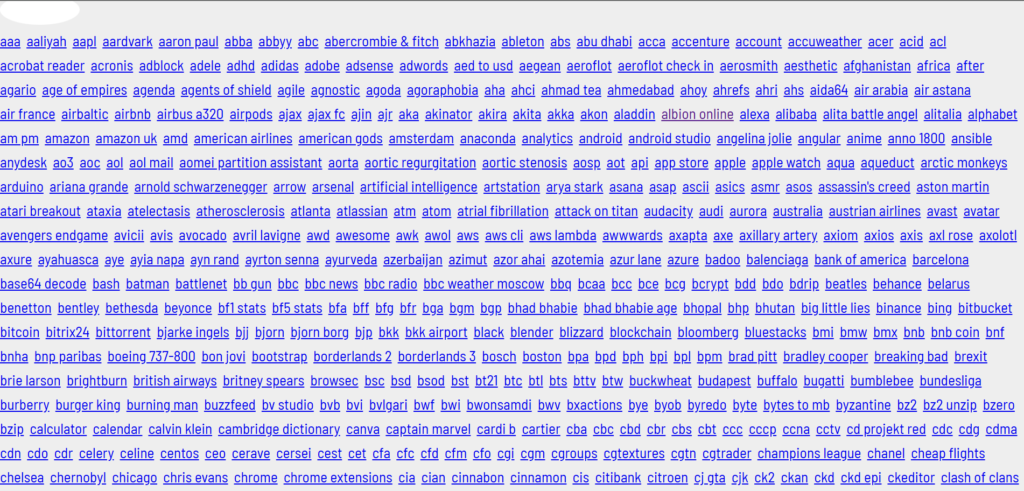
WHYS.video does not appear to generate topics randomly. The likely pipeline is more deliberate: identify trending questions through Google Trends, search those topics on Google, collect related questions from “People Also Ask,” then turn the results into simple narrated videos.
This would explain the strange range of topics. The channel does not behave like a human-curated educational brand. It behaves like a machine watching search demand and converting whatever people are asking into quick video content.
The process likely works like this:
Google Trends reveals a rising topic or question.
The operator searches that topic on Google.
Google’s “People Also Ask” box provides related long-tail questions.
The system collects or rewrites answers from Google results, snippets, or indexed pages.
Text-to-speech turns the answer into narration.
A simple video is generated using basic visuals, stock assets, templates, or automated graphics.
The finished video is uploaded to YouTube.
This model predates modern LLMs. WHYS.video has existed since 2019, so the earliest version likely relied on older automation: Google Trends, search scraping, templated scripts, text-to-speech, and simple video generation. More recently, large language models may have been added to rewrite answers, generate cleaner scripts, or produce more polished filler at scale.
The key point is that WHYS.video likely did not start as an AI content farm. It appears to have started as a search-driven video farm, then evolved into an AI-assisted search-driven video farm.
- Mechanized Q&A and Synthetic Interactivity
The site’s Q&A structure gives the impression of interactivity, but it does not feel like a real community or editorial system. It feels synthetic.
The questions are not signs of an active user base. They appear to function as search hooks: short, direct, Google-friendly phrases that can be turned into pages, captions, descriptions, and video topics.
This is where the operation becomes especially interesting. WHYS.video does not appear to be creating content because people follow the brand. It appears to be creating content because people search for isolated questions. The site catches those questions, converts them into answer-shaped pages, and then uses those pages to support video distribution.
- The Purpose of the Network: Turning Search Demand into YouTube Views
The purpose of the WHYS.video network appears to be driving YouTube views, not building a traditional website audience.
The likely strategy is simple: find what people are searching for, convert those questions into fast, low-cost narrated videos, and upload them to YouTube with titles that match search intent.
The websites then act as support infrastructure. They provide searchable text pages, category archives, cross-links, metadata, and a branded wrapper around the videos. But the core product appears to be the YouTube upload itself.
In plain terms, the network likely exists to turn Google Trends and Google Search questions into YouTube views.
A trending topic appears. WHYS.video searches it, harvests related questions from Google’s “People Also Ask,” generates a short answer, converts it with text-to-speech, adds simple visuals, and posts the result on YouTube.
That explains why the operation can publish across wildly unrelated subjects. It is not following an editorial mission. It is following search demand.
- Unintentional Self-Awareness in Content Curation
The platform’s automated chaos is perfectly captured by its “Entertainment-WHYS” sub-channel. The first video thumbnail features a prominent >_< emoticon.
In internet culture, >_< often signals frustration, error, discomfort, or intense confusion. It is an accidentally perfect mascot for the current state of WHYS.video.
Whether it is a glitch in an automated thumbnail system, a careless design choice, or just another artifact of mass-generated content, it visually summarizes the experience: polished surfaces wrapped around confused, low-context, heavily automated output.
- The Ghost Town Social Graph
For a platform claiming “mass presence” and presenting itself like a serious video knowledge brand, its social layer is nearly nonexistent.
Its linked social accounts show extremely low traction:
X/Twitter: 13 followers
Facebook: 26 followers
Instagram: 48 followers
These numbers do not prove the site has no traffic. A search-driven content farm can get visits without building a social following. But they do show that WHYS.video does not appear to have a meaningful organic community.
That distinction is important. The operation does not seem designed around subscribers, followers, or fans. It seems designed around search interception. The social accounts exist as legitimacy props, not as evidence of a real audience.
- The Bigger Pattern
When viewed together, the pieces form a consistent pattern:
The brand has existed since 2019.
The older model appears to have relied on Google searches, search-result scraping, “People Also Ask” style questions, and templated answer content.
Around 2023–2024, large language models likely made the answer-generation layer cheaper, faster, and more polished.
The recent redesign appears to wrap that older search-driven system in modern AI-generated branding and interface polish.
The network’s purpose appears to be driving views to YouTube by transforming Google search demand into video traffic.
The supposed corporate operator, Mass Presence LTD, has no obvious public trail across Google, Companies House, Wayback Machine, or ICANN Lookup.
This is not the story of WHYS.video becoming a legitimate platform. It is the story of an old content-farm strategy receiving an AI-era upgrade.
The Technical Verdict
The update confirms what the initial investigation suspected: WHYS.video has not matured into a real platform. It has modernized its machinery.
The site appears to have moved from basic Google-search-driven scraping into a hybrid model that combines Google-derived questions and answers with AI-generated filler, automated Q&A structures, generic generated UI, and YouTube-focused traffic capture.
The result is an algorithmic zombie: a network of sites designed to harvest search intent, generate answer-shaped content, and push viewers toward YouTube videos. The new branding, corporate footer, and polished interface do not resolve the old red flags. They simply make the operation look cleaner while the underlying incentives remain the same.
Proceed with caution, or better yet, don’t give them the clicks.